

CONTENT DIRECTION AND CLAIM CONTROL
Strategy & Evidence
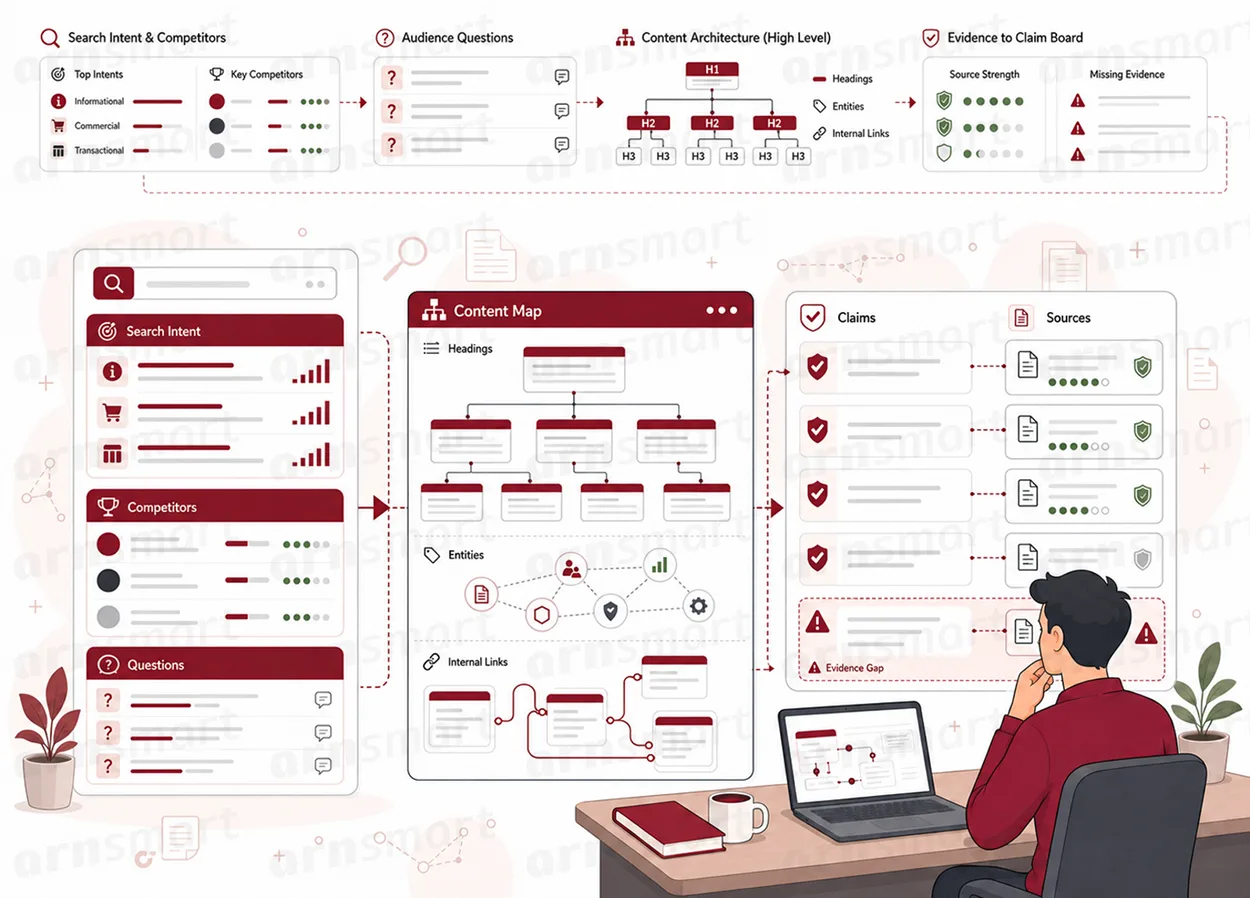
Contix Pro turns research into a content strategy before writing starts: a Content Blueprint, a risk and cannibalization screen, a Strategy Contract and a Content Architecture with section-level instructions. A Claim Ledger and a Source Ledger keep the article's factual claims and citations under review.
Every capability on this page belongs to Contix Pro. Contix Free moves from the research summary directly to a plan of two to eight sections.
Content Blueprint Pro
Decide what the article must contain before you outline it.
The Content Blueprint converts research into what should be created and why. It is the third stage of the Contix Pro pipeline and reads the topic request, the Language Pack and the research brief.
Content goal and required sections. The blueprint states the content goal and the sections the article cannot do without.
Search intent carried forward. The search intent chosen on the topic request and confirmed by research stays the reference for every later decision.
GEO and passage requirements. It lists the passages that answer systems need, such as self-contained answers to the audience's questions, together with schema signals.
The blueprint can be regenerated from the research workspace. This capability belongs to Contix Pro.

Search and Evidence Intelligence Pro
Check whether the article should be written at all, and how carefully.
The Search & Evidence Intelligence stage compares the topic with the site's existing content and with the topic's risk before strategy is set. It records a content action, a cannibalization screen, a risk profile, authority requirements, information gain and an evidence policy.
Content action. Contix proposes Create New, Create Supporting Article, Expand Existing, Refresh Existing, Merge Content or Do Not Create, with the reason and the affected pages. The decision waits for your approval, and an override needs a reason.
Cannibalization screen. Existing pages that already answer the same query are listed as conflicts with a low, medium or high risk.
Risk and evidence policy. Health, legal, financial, safety and similar topics raise the risk level. High-risk topics require primary or official sources, block unsupported claims and require human review.
| Risk level | Unsupported claim | Minimum source | Human review |
|---|---|---|---|
| Low | Qualify or review | Reputable source | Not required |
| High or critical | Blocked | Primary or official source | Required |
Search & Evidence Intelligence belongs to Contix Pro. It works from the site map and the research; it does not replace an editor's judgment.
Claim Ledger Pro
Know which statements need a citation before they reach the draft.
Contix Pro lists the factual claims the article is likely to make in a Claim Ledger. Each entry records whether a citation is required or recommended, the preferred source type, its verification status and whether human review is required.
Claims from research. The ledger starts from the claims the research brief marked for verification and the leading FAQ candidates, up to thirty entries.
Citation categories. Statistics, scientific, medical, legal, financial, performance, compliance and time-sensitive statements always need a citation.
Checked again later. Analysis and optimization report claim and source problems as Claim Ledger or source actions instead of rewriting text blindly.
| Ledger entry | What it shows | Action it suggests |
|---|---|---|
| Citation Required | Claim that needs direct support | Add a primary or official source, or remove the claim |
| Citation Recommended | Claim that needs support if it is specific | Qualify the wording or add a reputable source |
The Claim Ledger belongs to Contix Pro. It records what needs support; it does not judge whether a source is correct.
Strategy Contract Pro
Keep the reasons behind the article with the article.
The Strategy Contract fixes the direction of the article before its structure is built. Reviewers can read why the article is built the way it is without reconstructing the discussion.
Content model and angle. The contract records the selected content model, the primary angle, the unique position and the target outcome.
Messages and CTA direction. Primary and secondary messages, the reader outcome and the call-to-action direction follow the project's CTA style.
Evidence and boundaries. Required evidence, E-E-A-T signals, supporting topics, content boundaries and success criteria are stated, together with the strategic decisions and top priorities behind them.
- Open the Strategy Contract before reviewing a draft.
- Compare the contract's angle and boundaries with the draft's actual focus.
- Regenerate the contract when the strategy changes, then let the later stages run again.
The Strategy Contract belongs to Contix Pro.
Content Architecture Pro
Build the heading structure and the answer blocks before a sentence is written.
Contix Pro builds the Content Architecture from the Strategy Contract: the outline, a section map, entity placement, GEO blocks, an authority map, a schema plan and an internal link map. GEO blocks are short, direct passages where the article answers a specific audience question.
Outline and section map. The H2 and H3 structure follows the reader's questions, and each section owns its part of the topic.
Writing Blueprint. Minimum, recommended and maximum length, a coverage target, instructions for every section and an entity usage plan form the package the writer uses.
Your notes. Contix notes and your own notes stay next to the section instructions.
| Planning element | Input it uses | Output it produces |
|---|---|---|
| Outline and section map | Strategy Contract and audience questions | Ordered H2 and H3 sections |
| Entity placement | Entity intelligence | Entities assigned to sections |
| GEO blocks | GEO and AIO questions | Positions for direct answers |
| Writing Blueprint | All of the above | Length, coverage and section instructions |
Regenerating the architecture refreshes the section map, GEO blocks and Writing Blueprint, and marks Section Contracts and every later stage as outdated. Content Architecture belongs to Contix Pro.

Citation Planning and Source Ledger Pro
Decide where citations go and keep the source list reconciled.
Contix Pro checks every external citation in the finished article against the Source Ledger in the publishing step. A citation URL that cannot be matched to the ledger is reported, and a URL that appears without enough visible claim context is flagged for clearer placement.
Source policy. Sources are weighed by primary or secondary status, official status, relevance, authority, freshness, independence and citation suitability, without collapsing them into one score.
Citation placement review. Each external citation is located by line and checked for the claim it supports.
Source authority and freshness review. Weak or outdated sources are shown for review before transfer.
Citation planning and the Source Ledger belong to Contix Pro. The publishing step asks you to confirm the link and source review before the post moves to WordPress.

A Practical Strategy Workflow
- Read the research brief and the search data for the topic.
- Review the Content Blueprint and its GEO and passage requirements.
- Approve or override the proposed content action and check cannibalization conflicts.
- Read the risk level, evidence policy and Claim Ledger.
- Review the Strategy Contract's angle, messages, evidence and boundaries.
- Check the Content Architecture and the Writing Blueprint, then move to Section Contracts.
Questions About Strategy and Evidence
Is any of this available in Contix Free?
No. Contix Free goes from the research summary to a plan of two to eight sections and then to section-by-section writing. The blueprint, intelligence, Strategy Contract, architecture and both ledgers belong to Contix Pro.
What happens when the site already has a page on the topic?
Search & Evidence Intelligence proposes refreshing, expanding or merging the existing page, or not creating a new one, and waits for your decision. Duplicate production is held for review.
Does the Source Ledger verify that a source is accurate?
No. The Source Ledger checks which citations exist, where they sit and whether they match the ledger. Judging the quality of a source remains an editorial decision.
How do these plans reach the writer?
The Writing Blueprint becomes Section Contracts and Prompt Packages, and the Claim Ledger and evidence policy are available when sections are generated, validated and analyzed.
Continue Your Contix Workflow
Reviewed against Contix Pro 2.0.1 and Free 1.0.3 · Last updated 29 October 2026